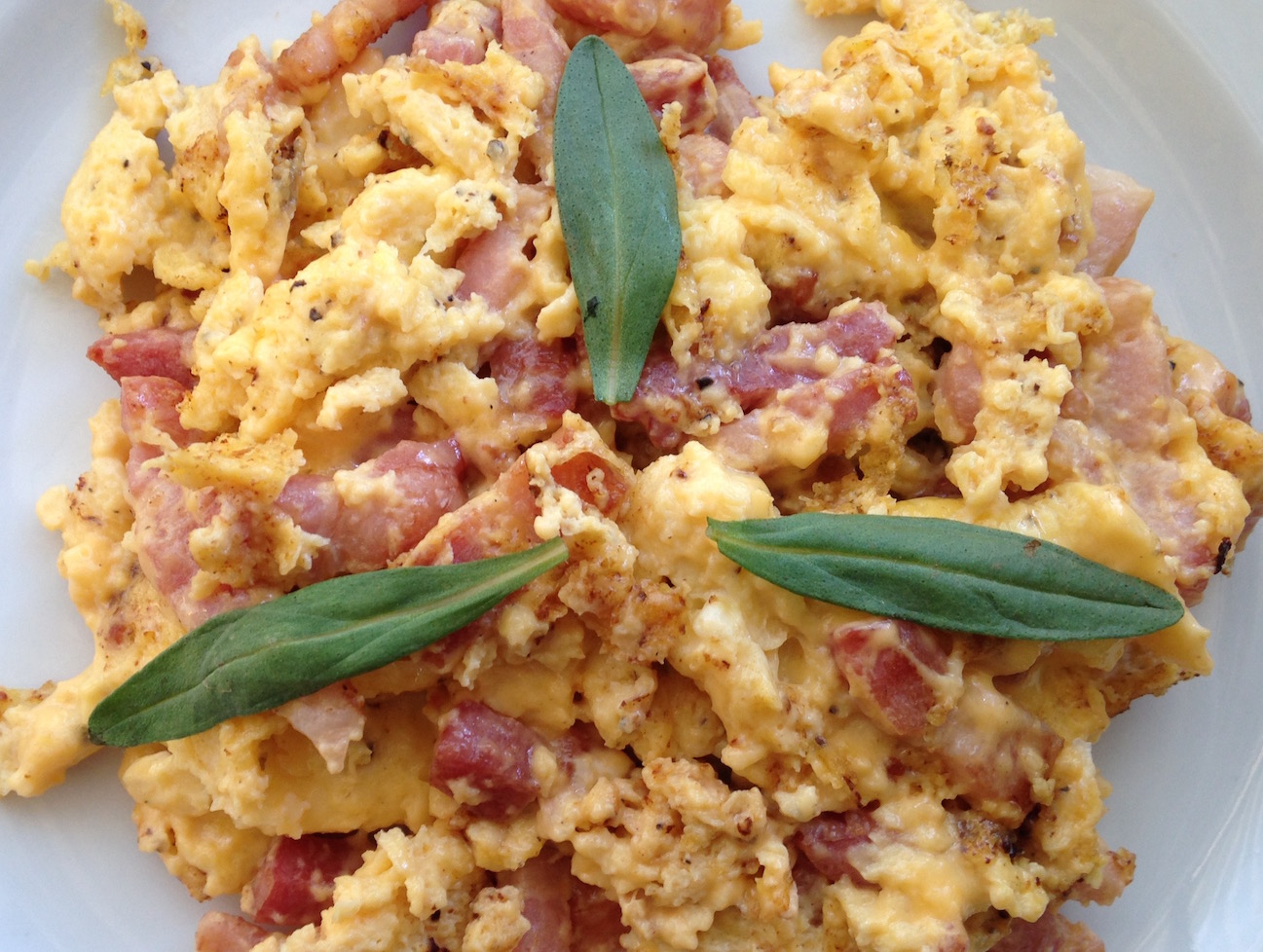
This is not an omelette, nor is it Paul Auster’s recipe. In fact, I’m not much of an Auster fan.
Let me explain. The first book of his New York Trilogy, City of Glass was an important part of my master’s thesis. There were many late at night surrounded by books. Eventually, I began to have that uneasy feeling familiar to graduate students, that I had partially begun to live inside the literature I was reading.
It was one of those nights when I came across a passage where the protagonist, who had been pretending to be a detective named Paul Auster, shares a lunch of ham omelettes with a writer actually named Paul Auster:
They sat there for a short time without saying anything. At last, Auster gave a little shrug, which seemed to acknowledge that they had come to an impasse. He stood up and said, “I was about to make some lunch for myself. It’s no trouble making it for two.”
Quinn hesitated. It was as though Auster had read his thoughts, divining the thing he wanted most – to eat, to have an excuse to stay a while. “I really should be going,” he said. “But yes, thank you. A little food can’t do any harm.”
“How does a ham omelette sound?”
“Sounds good.”
Auster retreated to the kitchen to prepare the food. Quinn would have liked to offer to help, but he could not budge. His body felt like a stone. For want of any other idea, he closed his eyes. In the past, it had sometimes comforted him to make the world disappear. This time, however, Quinn found nothing interesting inside his head. It seemed as though things had ground to a halt in there. Then, from the darkness, he began to hear a voice, a chanting, idiotic voice that sang the same sentence over and over again: “You can’t make an omelette without breaking eggs.”
He opened his eyes to make the words stop. There was bread and butter, more beer, knives and forks, salt and pepper, napkins, and omelettes, two of them, oozing on white plates. Quinn ate with crude intensity, polishing off the meal in what seemed a matter of seconds. After that, he made a great effort to be calm. Tears lurked mysteriously behind his eyes, and his voice seemed to tremble as he spoke, but somehow he managed to hold his own. (City of Glass, Penguin, 1987.)
A ham omelette. “Oozing on white plates,” no less. Reading those words, I realized I hadn’t thought about food for weeks. I had no idea what Auster, the writer-character, had put in his omelette, but it didn’t matter. I knew what I needed to do.
I threw on a sweatshirt and some shoes and walked to the only place in my neighborhood that sold pork products at that hour. Straight to the back, I grabbed a package of pancetta, a package of American cheese, some eggs and Lebanese bread.
Cracking and beating two eggs into a bowl, I unwrapped two slices of American cheese and tore them into pieces. Salt, pepper, a little bit of parm I had in the fridge. Done.
In the pan, I fried the pancetta until the fat rendered. I poured the eggs and cheese over the meat and waited until it had just set before haphazardly flipping over large pieces at a time. I plated the chunky scrambled eggs and dove in.
I ate with a similar intensity as Quinn. Once I was finished I got up, washed my plate, and slept for a dreamless ten hours.

The Paul Auster Omelette
Ingredients
2 eggs
2 slices American cheese
75g (2.5oz) pancetta, cubed or bacon, chopped
1 teaspoon grated parmesan
1 pinch each salt and pepper
1 round Lebanese bread, or any kind of thin flatbread
Instructions
1. Beat the eggs in a bowl.
2. Tear American cheese slices into approximately ½ inch pieces. Add to the eggs.
3. Heat a frying pan over a medium flame. Fry the pancetta or bacon, constantly stirring until the fat has partially rendered.
4. Pour the egg mixture over the pancetta and flip over in large pieces when it begins to set.
5. Take the eggs off the heat just before they begin to brown. They should still be soft.
6. Serve hot and eat using pieces of bread instead of a fork.
Serves 1

 theyellowlunchbox
Loved the excerpt! What a brilliant and charming way to wake up a recipe most of us take for granted.
LikeLike
Thanks Tiffany!
LikeLiked by 1 person